
How to Search Tate County Court Records
The right way to search Tate County court records depends on the court level and the record type. Circuit Court and Chancery Court files run through Mississippi Electronic Courts, the statewide system known as PAMEC. PAMEC is not a free, anonymous search. A user must register, pay an annual fee, and accept the access terms before viewing non-restricted documents, docket sheets, and notices. For people who would rather not open an account, the county keeps free public terminals at the clerk's office.
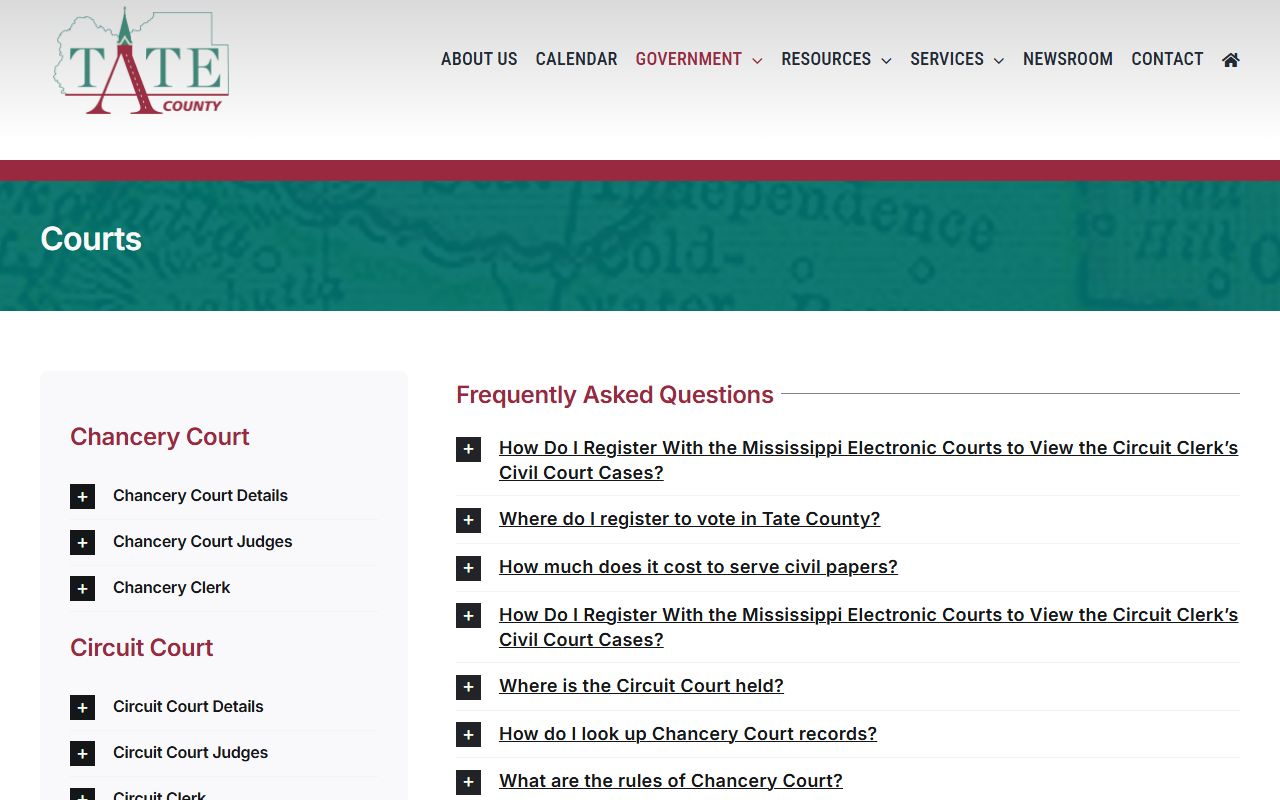
The county homepage gathers the quick links and FAQ entries that point residents to the correct office. A short look at the official Tate County government homepage shows how the county routes record requests to its courts and elected offices.

That same homepage feeds into the courts page and the FAQ, where the county explains the electronic system and the in-person fallback. The steps below follow the path the county itself describes.
- Identify the court. Felonies and big civil suits sit in Circuit Court, while divorce, probate, and guardianship sit in Chancery Court. Small claims, county misdemeanors, and county traffic belong to Justice Court, and city tickets go to a municipal court.
- For Circuit or Chancery records, register at the PAMEC site. Choose Attorney, Non-Attorney, or Firm Administrator, then pay the annual fee. Paying online usually grants same-day access, while a mailed check delays access until it clears.
- Search the proper court environment. Tate County Circuit Court runs in the 17th Circuit District system, and Tate County Chancery Court runs in the 3rd Chancery District system.
- Use the free public terminals when a document is not online. The Chancery Clerk's office offers terminals for Chancery Court records and land records at no charge.
- Request certified copies from the clerk who holds the file. Divorce decrees come from the Chancery Clerk, and marriage records come from the Circuit Clerk.
Justice Court and municipal records sit outside PAMEC. No public online case search was located for those courts, so a phone call or a counter visit remains the route. The PAMEC starting screen asks one question before new registration begins.
| Field Label | Type | Required | Options / Notes |
|---|---|---|---|
| User Type | Radio | Yes | Attorney, Non-Attorney, or Firm Administrator |
| Enter | Button | No | Moves the chosen user type into the sign-up workflow |
| Login / Maintain Account | Link | No | For users who already hold an account |
| Forgot Password | Link | No | Password recovery |
| Forgot Username | Link | No | Username recovery |
The Tate County Judicial System
Mississippi splits trial work between a law side and an equity side, so Tate County does not run every case through one general court. The Circuit Court is the law-side trial court for felonies, for civil actions of $200,000 or more, and for appeals from the lower courts and county boards. The Chancery Court is the equity-side court for divorce, support, custody, probate, guardianship, commitment, and juvenile matters. Below them, Justice Court and the municipal courts handle smaller and faster cases.
Tate County's Circuit Court belongs to the 17th Circuit Court District, with judges James McClure III and Smith Murphey. The Chancery Court belongs to the 3rd Chancery Court District, with chancellors Percy L. Lynchard Jr., Mitchell M. Lundy Jr., and Vicki Daniels, plus Youth Court Judge Sabrina Davidson Howell. The county's own Tate County courts page names these judges and lists the clerks who keep their records.
Appeals climb a clear ladder. A trial decision can move up for review, and the path holds for both criminal and civil matters.
Case flow: Justice or Municipal Court › Circuit or Chancery Court › Mississippi Court of Appeals › Supreme Court of Mississippi
| Court | Jurisdiction | Case Types |
|---|---|---|
| Supreme Court of Mississippi | Court of last resort | Final appeals; assigns many cases to the Court of Appeals |
| Mississippi Court of Appeals | Intermediate appellate | Appeals assigned by the Supreme Court |
| Circuit Court, 17th District | Law-side trial court | Felonies, civil $200,000+, appeals from lower courts |
| Chancery Court, 3rd District | Equity trial court | Divorce, probate, guardianship, commitment, juvenile |
| Justice Court | Limited jurisdiction | Small claims to $3,500, misdemeanors, county traffic, warrants |
| Municipal Court | City jurisdiction | City ordinance, city traffic, municipal misdemeanors |
The three busiest trial courts split the work in clear ways. A quick comparison shows where a case belongs and what each court can decide.
| Feature | Circuit Court | Chancery Court | Justice Court |
|---|---|---|---|
| Main work | Felonies, large civil | Equity, family, estates | Small claims, misdemeanors |
| Money limit | $200,000 and up | No fixed cap on equity | $3,500 or less |
| Jury trials | Yes, common | Rare; chancellor decides | Limited |
| Record access | PAMEC, Circuit Clerk | PAMEC, Chancery Clerk | Court phone or counter |
Note: Tate County's Circuit Clerk serves both the County and Circuit Courts, so a single office keeps the law-side case files for the county.
Tate County Courthouses
The Tate County Courthouse sits in downtown Senatobia and holds the Circuit Court, the Chancery Court, and the two clerk offices that keep their records. The Chancery Clerk, Tim Hale, works the first floor and oversees Land Records, Court Records, and Taxes. The Circuit Clerk, Kenda Blount, handles lawsuits, indictments, juries, marriage licenses, and voter registration. Justice Court and the Sheriff's Office sit at separate addresses in Senatobia.
State legal-aid groups list the courthouse as a public access point for residents who need help. The Mississippi Access to Justice partner page for the Tate County Courthouse records the building's address and phone for the public.
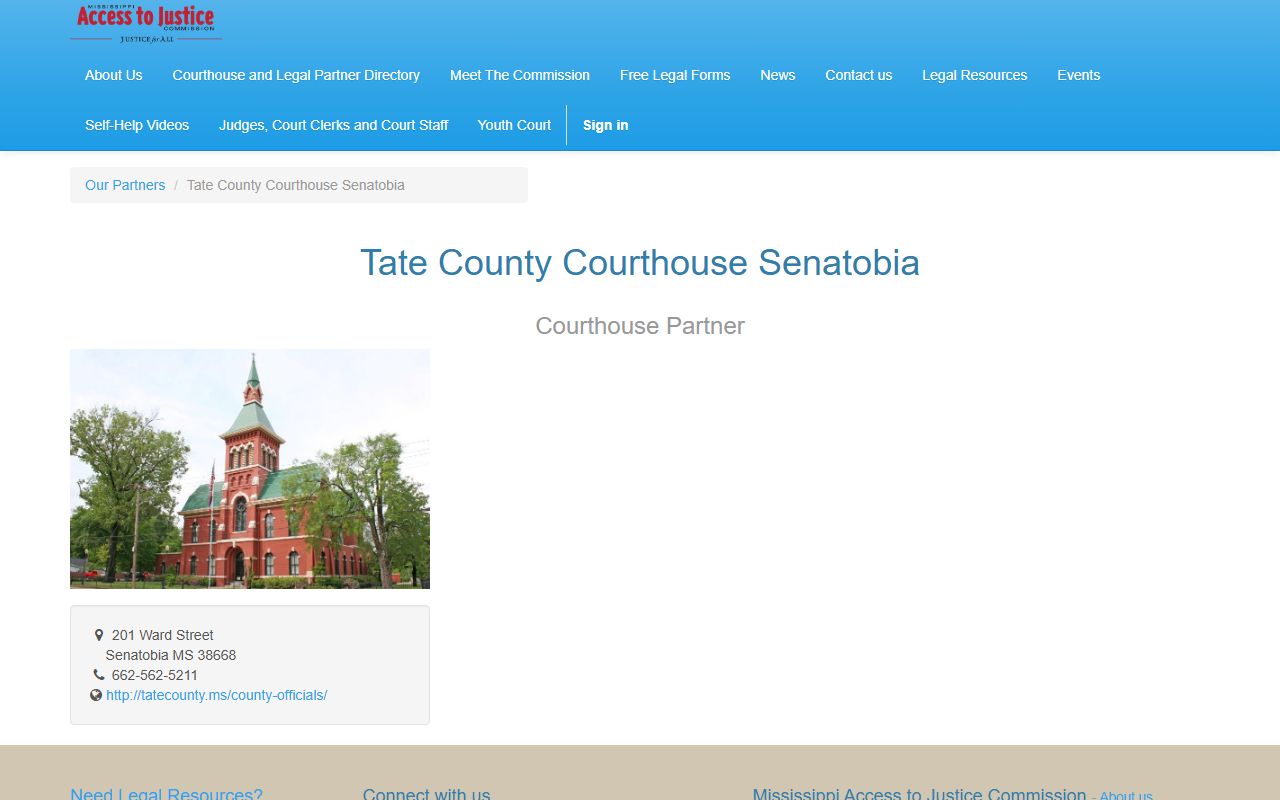
The address cards below cover the main courthouse plus the two other county venues that produce court records.
Tate County Courthouse
201 South Ward Street
Senatobia, MS 38668
662-562-5211
tatecountyms.gov
Tate County Justice Court
103 Preston McKay Drive
Senatobia, MS 38668
662-562-7626
tatecountyms.gov
Senatobia Municipal Court
131 North Front Street
Senatobia, MS 38668
662-562-5057
Coldwater also runs a municipal court at 444 Court Street, where court meets on the second Thursday of each month at 9:00 a.m. The Chancery Clerk's counter remains the universal fallback for county records that are not already published online.
Types of Court Records Available in Tate County
Tate County court records span every trial court in the county, and the record type tracks the court that made it. Circuit Court produces criminal and civil case files. Chancery Court produces family, probate, and guardianship files. Justice Court and the municipal courts produce small-claims, misdemeanor, and traffic files. The Circuit Clerk also keeps marriage licenses, while the Chancery Clerk keeps land records and board minutes.
The Circuit Clerk's office describes its filing duties in detail. The official Tate County Circuit Clerk page lists the lawsuits, indictments, jury records, and license records the office maintains.
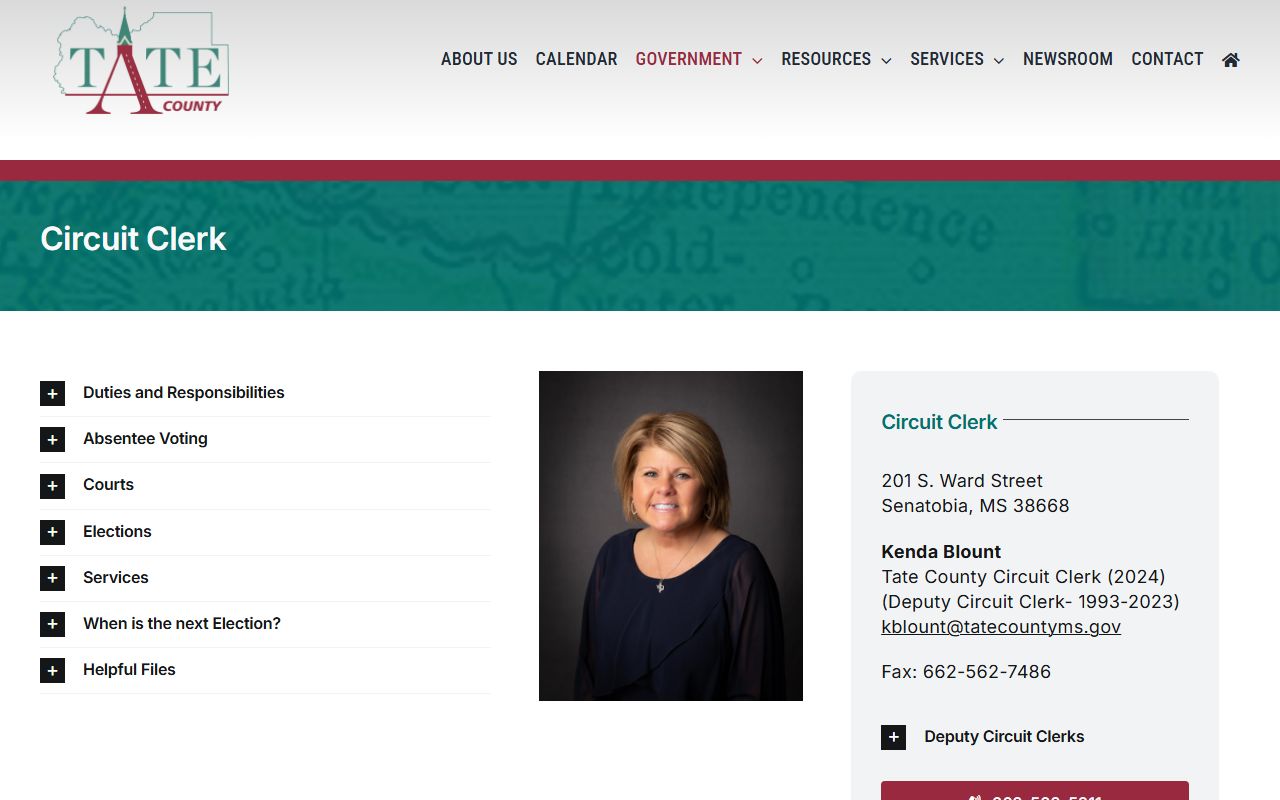
The main categories most people search are grouped below, with the court that holds each one.
- Criminal records - Felony indictments, pleas, verdicts, and sentences from Circuit Court, plus misdemeanors from the lower courts.
- Civil records - Complaints, motions, judgments, and appeals for civil actions of $200,000 or more in Circuit Court.
- Family and divorce records - Divorce decrees, support, and custody filings kept by the Chancery Clerk.
- Probate records - Wills, estates, guardianships, and conservatorships handled in Chancery Court.
- Traffic records - County and Highway Patrol citations in Justice Court, plus city tickets in municipal court.
Land records and board minutes are not case files, yet the public searches them often. Both run through the Chancery Clerk and the county's online tools.
What Tate County Court Records Show
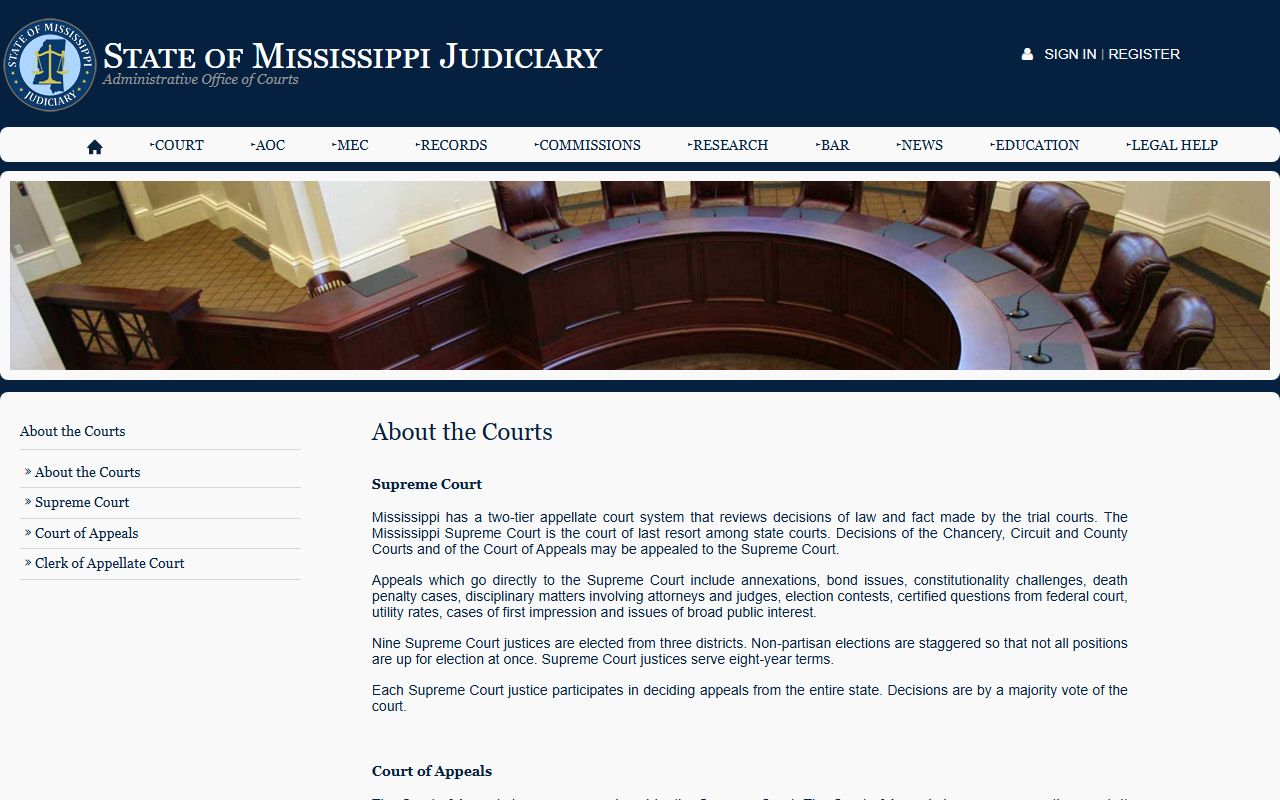
A Tate County court record carries a set of standard fields, no matter which court built it. The court name, the case number, the parties, and the docket entries appear on almost every file. Criminal files add charges, pleas, and sentences. Chancery files add petitions, decrees, and accountings. The Mississippi Judiciary explains how each court fits together and what its records cover.
A short read of the Mississippi Judiciary court-structure overview helps a searcher match a record to the court that issued it.
The table below lists the common fields and what each one tells a reader.
| Field | What It Shows |
|---|---|
| Case Number | The court's assigned tracking number for the file |
| Filing Date | When the case opened or the document was filed |
| Parties | Plaintiff and defendant, or petitioner and respondent |
| Charges / Cause | The crime charged or the legal claim raised |
| Disposition | The outcome, such as a plea, verdict, or dismissal |
| Sentence / Judgment | The penalty imposed or the rights and money awarded |
Docket flags add quick status notes. The 17th Circuit system shows flags such as Bench Warrant Issued and Capias Pending, while the 3rd Chancery system shows flags such as Accounting Filed and Adult Ward.
Public Access Laws for Tate County Court Records
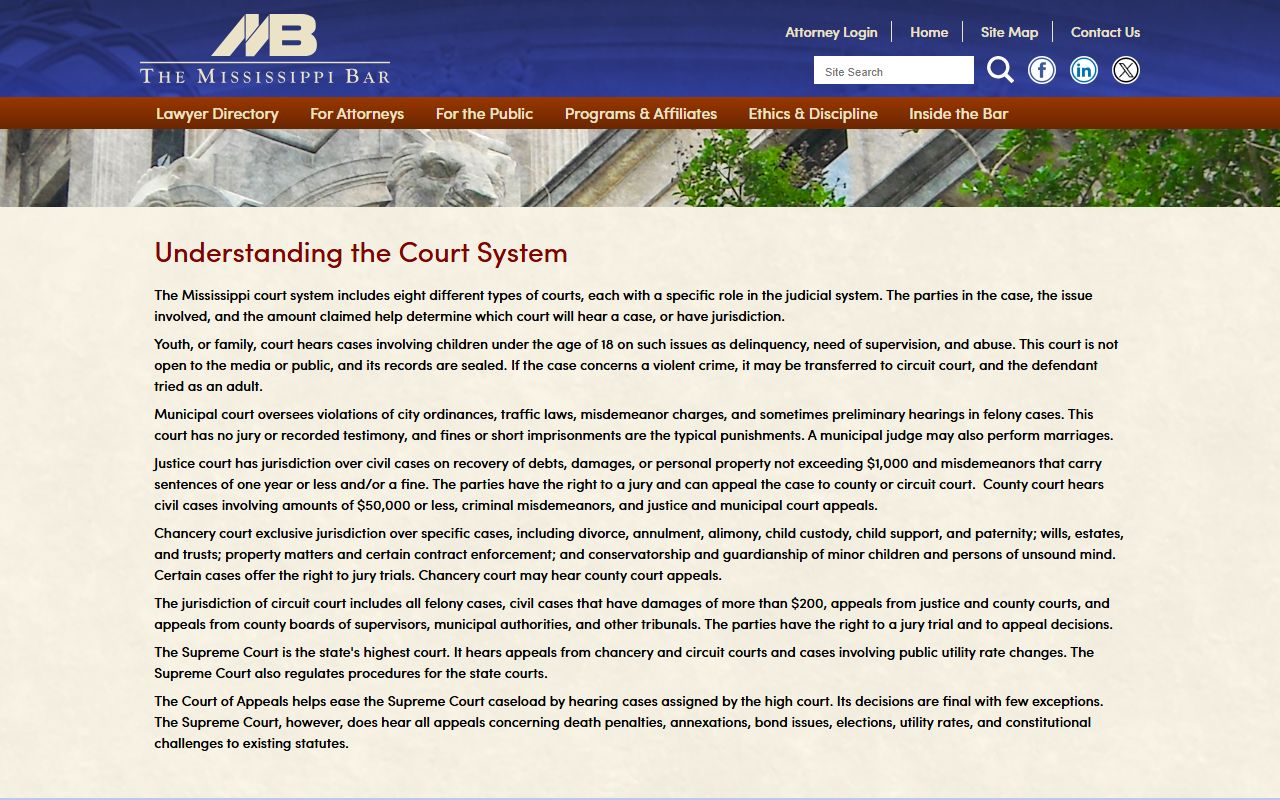
Mississippi law treats court and government records as open by default. The Public Records Act sets the rule that records stay available for inspection unless another law shields them. County offices may require a written request and may charge the actual cost of search, copying, and mailing. The Mississippi Bar offers a plain overview of how these courts and access rules work.
The Bar's guide to understanding the court system walks the public through each court's role in Tate County and statewide.
Three statutes shape what a searcher can and cannot see in Tate County. Criminal warrants, initial appearances, and bond steps also follow the Mississippi Rules of Criminal Procedure.
Key Statutes:
Miss. Code § 25-61-1 - The Public Records Act keeps government records open for inspection unless a law says otherwise.
Miss. Code § 99-19-71 - The expungement law lets eligible people petition to erase qualifying arrests and convictions from public view.
Miss. Code § 43-21-261 - Youth-court records stay confidential and are released only when the law allows.
Records That Are Restricted or Confidential
Not every Tate County court record reaches the public. Youth-court files cover delinquency, supervision, abuse, and neglect, and state law keeps them confidential. Adoption files are restricted, and access usually needs party status or a court order. Mental-health and commitment hearings carry medical details, so they stay sensitive. Personal identifiers such as Social Security numbers and minor children's data are redacted or withheld.
Expungement is the other reason a record disappears from a normal search. Once a court grants an order under the state expungement statute, the case should no longer show up in clerk searches or in PAMEC public access. The Mississippi Judiciary publishes the court rules that govern these filings.
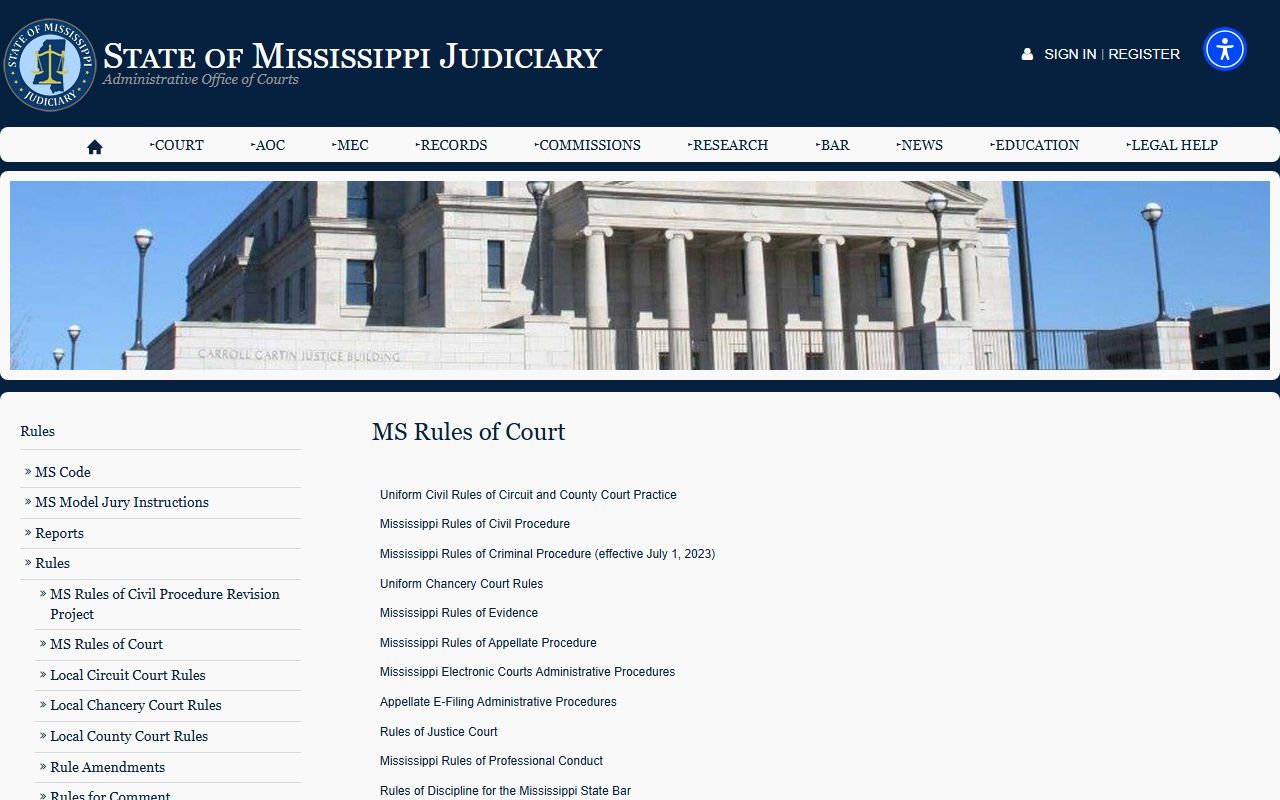
A resident seeking expungement files in the court that handled the case, whether Justice, municipal, or Circuit Court. The Mississippi Judiciary court rules page hosts the statewide and district rules that apply. A clerk cannot give legal advice, so the county FAQ points people to legal-aid groups instead.
Specialty Courts in Tate County
Tate County runs a Juvenile Drug Court tied to its Chancery and Youth Court structure. The county describes it as a three-phase program for juveniles on probation who struggle to stay clean and sober. The program targets young people already under court supervision, not adults, and it focuses on sobriety and compliance rather than ordinary criminal punishment.
Adult drug-court activity does surface in custody data, since jail roster entries sometimes list a drug-court sanction as a hold. Still, the only official program the county describes is the Juvenile Drug Court. Program length, graduation rates, and participant counts were not published, so those details stay unconfirmed.
Tate County Sheriff and Jail
The Tate County Sheriff's Office runs the county jail and the best online custody lookup. The office sits at 1 Justice Drive in Senatobia, with a main line of 662-562-4434 and a jail line of 662-562-5466. An official app and website carry an inmate roster, a most-wanted feed, a sex-offender map, a tip form, and commissary links. The app, released in 2025, centralizes the tools the public uses most.
The roster feed shows current bookings with names, ages, charges, and bond data, which makes it the strongest pretrial jail source for the county. People sentenced to state prison move to a separate state system. For the full roster, booking fields, and contact details, the Tate County inmate records page goes deeper, and the warrant records page covers active warrants and the most-wanted list.
Note: The current sheriff's name was not published in the official sources reviewed, so confirm it directly with the Sheriff's Office before citing it.
Marriage, Divorce, and Probate Records
Marriage and divorce records split between two offices in Tate County. The Circuit Clerk issues marriage licenses and keeps marriage records. Divorce decrees come from the Chancery Clerk, not the state health department, which holds only a five-year divorce index for locating the county and book. The state vital-records office can still provide certified marriage copies for statewide purposes. Probate, wills, estates, and guardianship all run through Chancery Court.
A few estate terms come up often in Tate County probate files. Their plain meanings help a reader follow a will or guardianship case.
- Testator
- The person who made the will being probated.
- Executor
- The person named in a will to settle the estate.
- Conservator
- A person the court appoints to manage another adult's affairs.
For the application steps, fees, and certified-copy routes, the dedicated marriage and divorce records page and the probate records page carry the full detail.
Federal Court Records for Tate County
Some Tate County cases never reach a state court. Federal crimes, civil-rights suits, and federal-question cases go to the U.S. District Court for the Northern District of Mississippi. Those files live in the federal CM/ECF system and PACER, not in PAMEC. A debtor's bankruptcy is federal too, handled by the U.S. Bankruptcy Court for the Northern District, and it stays separate from a Tate County Chancery probate.
Federal appeals from Mississippi go to the Fifth Circuit. A party who lives in Tate County does not create a federal case by residence alone, so a file appears federally only through federal prosecution, a removed case, a bankruptcy, or a federal appeal. Federal prison custody is searched through the Bureau of Prisons locator rather than the county jail roster.
Tate County Court Records Fees
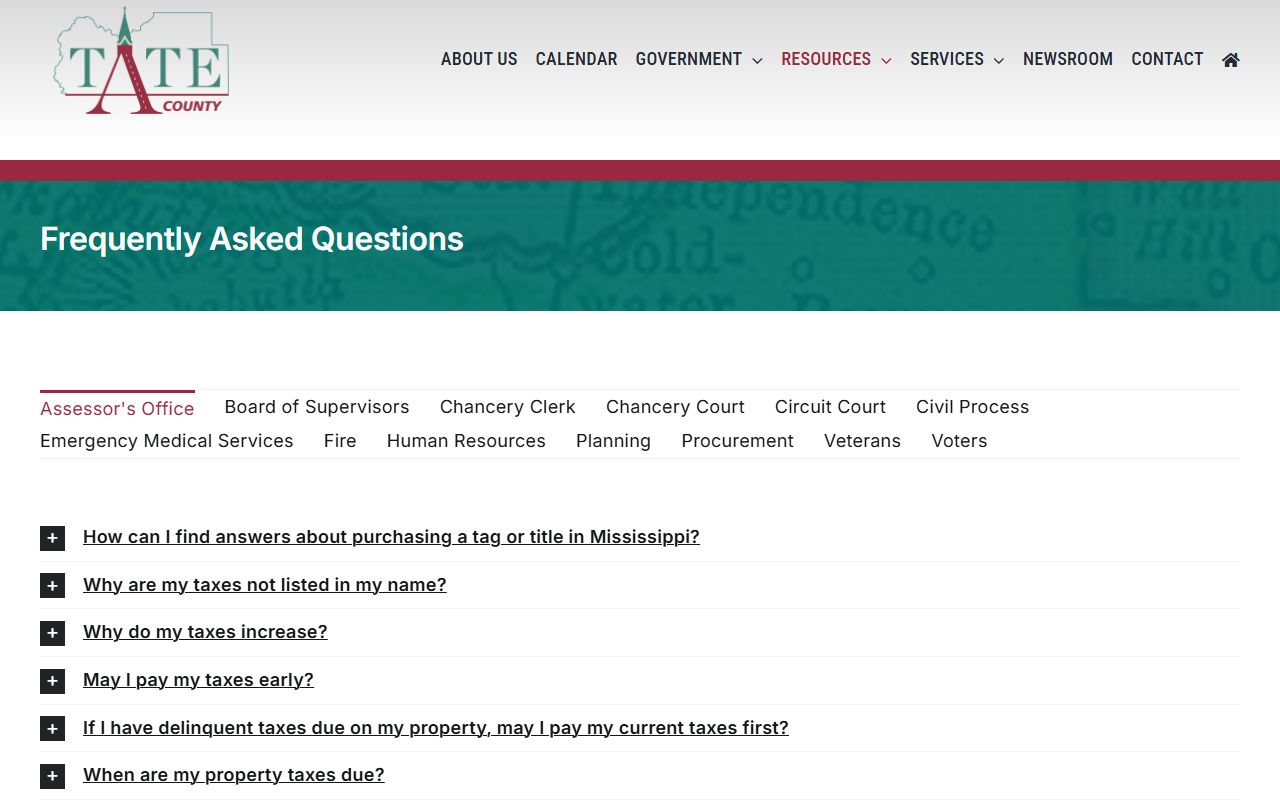
Court-record costs in Tate County depend on the office and the copy type. PAMEC charges an annual registration fee plus a per-page charge for search results, and that page charge applies even when a search returns no match. Divorce copies from the Chancery Clerk cost less from a public terminal than from staff, and each carries a certification fee. The Sheriff's Department charges a flat fee to serve civil papers.
The county FAQ posts these amounts and the request routes that go with them. A look at the Tate County FAQ shows the divorce-copy, registration, and service-fee details together.
The common fees are gathered in the table below.
| Item | Amount |
|---|---|
| PAMEC annual registration | $10 |
| PAMEC per page of search results | $0.20 |
| Divorce copy, public terminal | $0.25 per page plus $1 certification |
| Divorce copy, staff printed | $0.50 per page plus $1 certification |
| Civil paper service by Sheriff | $35 first paper, $1 each added paper |
Note: PAMEC bills its charges quarterly, with statements sent in January, April, July, and October, so per-page costs can stack up across a billing period.
How to Read Tate County Court Records
Court files use shorthand that can confuse a first-time reader. A charge is not the same as a conviction, and a docket flag is not a final outcome. Knowing a handful of terms makes a Tate County record much easier to follow. The words below appear across criminal, civil, and chancery files.
- Disposition
- The outcome of a charge or case, such as a plea, verdict, or dismissal.
- Capias
- A writ ordering an arrest, often after a missed court date.
- Bench warrant
- A warrant a judge issues for a no-show or for contempt.
- Bound over
- A lower-court finding that a felony should move to the grand jury.
- Continuance
- A postponement of a hearing or trial to a later date.
A conviction means a guilty plea or a guilty finding, while a charge only names an accusation. An expunged case should drop out of public view entirely, so its absence does not mean a person was never charged.
History of Tate County Courts
Tate County was organized in 1873, with Senatobia as its county seat along Interstate 55. The story of its court records is less about old buildings and more about the shift to electronic filing. Mississippi's split law and equity courts shaped the county's records long before computers, and the modern system layered an online portal over that structure.
Electronic filing reached the county in 2015. Chancery Court e-filing became mandatory that June, and Circuit Court followed with its own voluntary and mandatory dates the same year. In 2025, the state announced that electronic filing was complete across all 82 counties. That milestone is why Tate County users are sent to PAMEC and to courthouse public terminals rather than to a separate county-built database.
Frequently Asked Questions
How do I search Tate County Circuit and Chancery court records online?
Both courts run in Mississippi Electronic Courts, the PAMEC system. A user registers as an Attorney, Non-Attorney, or Firm Administrator, pays the annual fee, and accepts the terms. After access opens, the searcher uses the 17th Circuit District environment for Circuit Court and the 3rd Chancery District environment for Chancery Court. Restricted cases stay out of public view. Anyone who would rather not open an account can use the free public terminals at the Chancery Clerk's office instead.
Are Tate County court records free to view?
The public terminals at the courthouse are free for Chancery Court records and land records. PAMEC, by contrast, charges a small annual fee and a per-page charge for search results, even when a search finds no match. Copies and certifications cost extra. So the records are public, but online access through PAMEC carries fees, while the in-person terminals do not.
Where do I get a certified divorce decree in Tate County?
Certified divorce decrees come from the Tate County Chancery Clerk, not the state health department. A person can use the public terminals for $0.25 per page plus a $1 certification, or ask staff to print for $0.50 per page plus the same certification. Mailed requests go to the Chancery Court at the courthouse address with payment and a self-addressed stamped envelope. The state office holds only a five-year divorce index to point you to the right county.
Which court handles traffic tickets in Tate County?
County and Highway Patrol citations go to Tate County Justice Court at 103 Preston McKay Drive. City tickets go to the municipal court for that city, either Senatobia or Coldwater. Coldwater holds court on the second Thursday of each month and lets drivers pay eligible fines online, though paying before court enters a guilty plea. Some charges, such as no driver license or DUI, cannot be paid online.
How do I find someone in the Tate County jail?
The Tate County Sheriff's Office posts an inmate roster through its official website and app. The roster shows names, ages, charges, and bond data for current bookings, which makes it the best online source for county custody. For someone sentenced and moved to state prison, the state corrections inmate search is the right tool. The jail line is 662-562-5466 for questions the roster does not answer.
Can I check for an active warrant in Tate County online?
No complete online warrant search was located for the county. The sheriff app does publish a most-wanted feed, and the jail roster can reveal warrant-related holds after an arrest. For an active warrant before arrest, the route is to call the issuing court. Justice Court handles county warrants, a municipal court handles city ones, and Circuit Court handles felony capias and bench warrants.
How do I request a county record that is not online?
The county routes public-information requests to Tim Hale, the Chancery Court Clerk, at the Tate County Courthouse. A requester completes the Public Information Request form and submits it to that office. Many records are already free on the county website, so the form covers the records that are not. Active investigations, sealed warrants, juvenile files, and other restricted materials may be withheld under state law.