
What Probate Covers in Tate County
Probate sits with the Chancery Court in Mississippi, not the Circuit Court. Tate County Chancery Court hears wills and estates, and it holds authority over probate, guardianship, and sanity matters. The same court handles conservatorships and the affairs of adult wards who can no longer manage their own decisions. Equity work like this has always belonged to the chancery side of Mississippi's split court system. The Mississippi Judiciary explains that Chancery Courts handle estates, minors' business, land titles, and related equity matters.
Tim Hale is the Tate County Chancery Clerk and the clerk of the Chancery Court. His office is split into Land Records, Court Records, and Taxes. The Court Records counter is where probate files live. A death does not move an estate into federal court or into the Circuit Clerk's office. Wills, letters, inventories, and accountings all flow through the Chancery Clerk instead. The county's own courts page confirms that Chancery Court carries probate, guardianship, and sanity jurisdiction for Tate County residents.
Divorce and custody run through this same court. Estate files and family files share the Chancery Clerk's counter, though each opens as a separate case. The decrees behind a marriage that ends are covered under Tate County marriage and divorce records.
Probate Terms Defined
Probate paperwork uses words that rarely come up in daily life. A short glossary helps a reader make sense of a will, a petition, or a docket entry before heading to the clerk's counter. The terms below appear across most Tate County estate files.
- Testator
- The person who made the will. A testator names who should inherit and who should manage the estate.
- Executor
- The person named in a will to carry out its terms, pay debts, and distribute what is left.
- Administrator
- The person the court appoints to settle an estate when there is no will or no named executor able to serve.
- Intestate
- Dying without a valid will. State law then sets who inherits the estate.
- Letters Testamentary
- The court order that proves an executor's legal power to act for the estate. Letters of administration serve the same role when there is no will.
- Guardianship
- A court relationship that lets one person care for and make choices for a minor or an incapacitated adult.
- Conservatorship
- A court arrangement that gives a conservator control over the money and property of someone who cannot manage their own affairs.
How to Search Tate County Probate Records
Tate County keeps Chancery Court records in Mississippi Electronic Courts, known as MEC. The public side of that system is PAMEC. It is not a free, anonymous search box. A user registers, pays the annual fee, and accepts the terms before viewing non-restricted docket sheets and documents. For people who want help or a certified copy, the clerk's counter and free public terminals still matter.
- Confirm the estate belongs in Tate County. Probate is filed where the person lived, so an out-of-county estate may sit in a different chancery district.
- Register for an account on the PAMEC registration page. Choose Non-Attorney if you are a member of the public, then pay the annual fee.
- Search the Third Chancery District environment, where Tate County Chancery cases live. Look up the estate by party name or case number.
- For older or non-digitized files, use the free public terminals in the Chancery Clerk's office. Staff can point you to the right book and page.
- Ask the clerk to print or certify copies, or mail a written request with the correct payment and a self-addressed stamped envelope.
Note: PAMEC charges by the number of pages a search returns, and even a no-match search counts as one billable page.
Tate County Chancery Court Office
Tate County Chancery Court belongs to Mississippi's Third Chancery Court District, which also covers DeSoto, Grenada, Montgomery, Panola, and Yalobusha counties. The district chancellors are Percy L. Lynchard Jr., Mitchell M. Lundy Jr., and Vicki Daniels, with Sabrina Davidson Howell serving as Youth Court Judge. The court went live in MEC on April 4, 2015, so most filings since then carry an electronic record. The contact details below cover probate filings, copy requests, and public terminal access.
Tate County Chancery Court / Chancery Clerk
201 Ward Street
Senatobia, MS 38668
662-562-5661
Mon-Fri 8:00 a.m. to 5:00 p.m.
How Probate Works in Tate County
Probate follows a fairly steady path, even when an estate is large or contested. The Chancery Clerk opens the file, the chancellor reviews it, and a fiduciary then carries the estate to a close. The steps below show how a typical Tate County estate moves from the first petition to a final discharge.
- Decide what the matter is: a will, an estate administration, a guardianship, a conservatorship or adult ward, or another chancery issue.
- File the petition or application in Tate County Chancery Court when Tate County is the correct venue.
- The Chancery Clerk opens the court file and collects the filing fees.
- The chancellor reviews the filing and may require an oath, a bond, formal notices, or a hearing.
- If the estate is opened, the court issues letters or orders that authorize the fiduciary to act.
- The fiduciary gives notice, manages assets, files any required inventory and accountings, and resolves creditor claims.
- The court reviews the final accounting, approves distribution, and discharges the fiduciary to close the estate.
Tate County Probate Filing Fees
Tate County does not publish a probate filing fee schedule on its official pages. The honest answer is to call the Chancery Clerk for the current opening cost of an estate or a guardianship before you file. Land-record recording fees are a separate schedule and do not apply to probate. The clerk's copy and certification charges, however, are known and appear below.
| Item | Amount |
|---|---|
| Probate or guardianship filing fee | Not published; call the Chancery Clerk |
| Public-terminal copy | $0.25 per page |
| Staff-printed copy | $0.50 per page |
| Certification | $1 per document |
| PAMEC document or data access | $0.20 per page |
Important: No official Tate County source lists a flat probate filing fee. Do not rely on a deed-recording rate as a probate cost. Confirm the amount with the Chancery Clerk at 662-562-5661 before filing.
What Tate County Probate Records Show
A probate file grows as an estate moves through the court. Early documents prove the death and name a fiduciary. Later ones track the money, the property, and the people who receive a share. Most Tate County estate files hold a familiar mix of papers, and the same documents show up in guardianship and conservatorship cases.
- The petition or application to open the estate, plus the original or a copy of any will.
- A death certificate or other proof of death, with an oath and a bond when one is required.
- Letters testamentary or letters of administration that authorize the fiduciary.
- Notice to creditors and any claims filed against the estate.
- An inventory and appraisal of estate assets and an accounting of money handled.
- Petitions to sell property, court orders, receipts, waivers, and the final discharge.
The Chancery docket also carries status flags that signal where a case stands. Two flags seen on the Tate County Chancery system are "Accounting Filed - Order Due" and "Adult Ward." The first tells the court an accounting is in and a ruling is pending. The second marks a guardianship or conservatorship over an adult. These flags appear alongside the same kind of entries found across the county's court records.
Tate County Estate Notice Channels
The Tate County Sheriff's Office runs the county's main public-safety apps and social pages. These channels are not probate tools, but families settling an estate often watch them for county notices, office closures, and public alerts. The official iOS build is listed on the Apple App Store under Tate County Government.
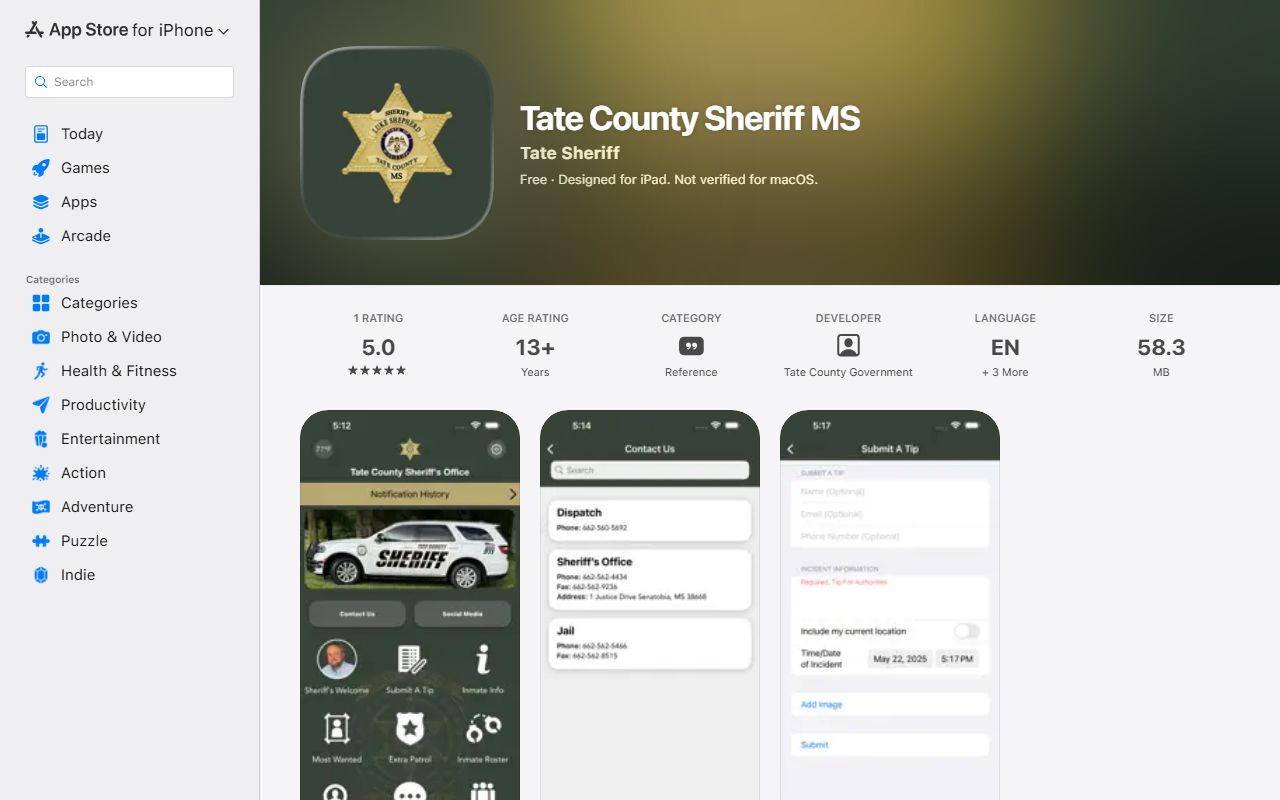
The listing shows the same app the county promotes for news, contact, and county updates a probate family may also need to follow.
Android users get the same features from a separate store page. The Google Play listing carries the official Tate County Sheriff app for phones and tablets.
Installing it keeps county news and contact links one tap away while an estate moves through Chancery Court.
The county also posts updates to social media. The Tate County Sheriff Facebook page shares public notices and office information for residents.
None of these channels replace the Chancery Clerk's counter, but they help residents stay current on county business while a case is open.
Restricted Probate Records
Most estate filings are open under Mississippi's Public Records Act, found at Section 25-61-1, which keeps court files available for inspection unless the law says otherwise. Probate is largely a public process, so a routine will, inventory, or accounting is usually viewable through PAMEC or a public terminal. Several categories, though, stay closed or heavily redacted.
Guardianships and conservatorships often involve a minor or a vulnerable adult. Medical details, mental-health records, and a ward's personal information can be sealed or withheld. Adoption files connected to a chancery matter are restricted, and access usually requires party status or a court order. When a probate matter touches a juvenile, Mississippi Code Section 43-21-261 keeps youth-court records confidential except for authorized disclosures.
Note: sensitive identifiers such as Social Security numbers, financial account data, and protected addresses are redacted even when the rest of an estate file stays open to the public.